 |
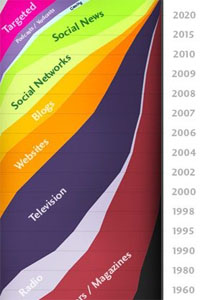
| Digestivo nº 429 Passado, presente e futuro da informação, por Thomas Baekdal Para profissionais de comunicação perdidos – como quase todos hoje –, Thomas Baekdal, editor da revista que leva o seu nome, criou uma interessante linha do tempo. Reconstituindo o papel da informação em nossas vidas desde o século XIX, e de maneira gráfica, Baekdal consegue organizar uma história que, por escrito, pode parecer mais complicada. Em seu post entitulado “Where is Everyone?” (Onde está todo mundo?), ele se propõe a ajudar comunicadores que ainda desejam contatar seu público, arriscando, inclusive, alguma futurologia. Voltando no tempo, Baekdal explica que, antes do século XIX (antes dos impressos), predominava a comunicação “face a face”. Com a chegada dos jornais, do século XIX em diante, se você quisesse informação, tinha de ler a respeito. A partir das primeiras décadas do século XX, o rádio foi roubando espaço dos jornais, que eram predominantes – mas o impacto maior, sobre os impressos, viria a partir de meados do século passado, com a televisão. A TV reinou até o fim do século XX, quando surgiu a internet. A Web da década de 1990 obrigava todo mundo a ter um site, e tirava o consumidor de informação de sua passividade, obrigando-o a escolher por onde navegar. Mas a internet continuaria sua evolução, com a Web 2.0, em meados dos anos 2000 – dos blogs às redes sociais. Você não escolheria mais qual informação receber, mas, sim, qual informação não receber (dado o enorme fluxo de informações). Mais para o fim dos anos 2000, surgiria o Twitter – e, no lugar da “blogosfera”, a “statusfera”. A TV deixaria de ser a primeira fonte de informação... Até hoje. No futuro (não tão distante), Baekdal prevê que cada um de nós será uma “central” – de geração, distribuição e consumo de informações. Sem intermediários: sem jornalistas e sem meios de comunicação. E ao vivo, com streamings de áudio e vídeo – via celular. Thomas Baekdal, no Brasil, seria chamado de “xiita”. O pior é que ele não inventou nada, apenas organizou o que, nos seus gráficos, qualquer um agora pode enxergar. Até profissionais de comunicação... |
Mostrar mensagens com a etiqueta Rede Social. Mostrar todas as mensagens
Mostrar mensagens com a etiqueta Rede Social. Mostrar todas as mensagens
segunda-feira, 28 de dezembro de 2009
Passado, presente e futuro da informação, por Thomas Baekdal


domingo, 27 de dezembro de 2009
Steve Jobs, o CEO da década, segundo a Forbes / Passado, presente e futuro das mídias sociais, por Erik Qualman
 | |
| Digestivo nº 441 >>> Steve Jobs, o CEO da década, segundo a Forbes | . “Jovem fundador leva um ‘pé’ da própria empresa nos anos 80, retorna nos 90, e na próxima década – enquanto sente o bafo da morte duas vezes, passa por um forte escândalo financeiro e refaz sua linha de produtos –, torna-se a personalidade dominante em quatro indústrias diferentes, bilionário várias vezes, e o presidente da empresa mais valiosa do Vale do Silício”. Assim abre Adam Lashinsky, editor da Forbes, que, em sua última edição, acaba de eleger Steve Jobs, fundador e presidente da Apple, o “CEO da década”. Jobs, sugere Lashinsky, é o ser humano mais próximo, em nossa época, de ter o toque de Midas. Nos últimos dez anos, redefiniu, simples e apenasmente, três mercados: o de música, o de filmes e o de celulares (sem contar o impacto em seu mercado de origem, o de computadores). Além de homem de negócios, Jobs é hoje uma celebridade. Alguém que conseguiu levar seu slogan – Think different – ao pé da letra, impondo um design de bom gosto, invadindo o “varejo” com lojas elegantes e redefinindo até o papel da propaganda. O que o move, segundo Larry Ellison, CEO da Oracle, um amigo próximo, não é o dinheiro – mas, desconfia a Forbes, sua paixão pela Apple (seu “primeiro amor”) e uma possibilidade de, através dela, efetivamente mudar o mundo. Se em 2000, quando Jobs lançou a estratégia do “digital lifestyle”, a Apple valia 5 bilhões na bolsa, hoje, menos de uma década depois, ela vale 170 bilhões de dólares (um pouquinho mais que o tão falado Google). Já Jobs, quando vendeu a Pixar à Disney em 2006 por 7,5 bilhões, tornou-se, magicamente, o maior acionista “pessoa física” da empresa que detém os direitos do Mickey. “Será que ele vai se sentir tão confortável no mainstream, nos próximos dez anos, quanto se sentiu no underground, nas décadas passadas?”, indaga a mesma Forbes. Larry Page e Sergey Brin, os dois fundadores do Google, recentemente declararam, à revista New Yorker, que Steve Jobs é seu herói. E o mundo se pergunta, neste momento, qual será o próximo passo do gênio... Se ele sempre evitou se expor, e guardou seus segredos até o último minuto, não temos como adivinhar, resigna-se a mesma reportagem da Forbes. . >>> The decade of Steve |
 | |
| . “As tais mídias sociais são apenas uma moda passageira?”, começa perguntando o vídeo de Erik Qualman, um escritor americano de ficção e livros de business, que circula pela internet através do YouTube e que foi recentemente traduzido, para o português brasileiro, pelo blog Sedentário & Hiperativo. Tirando o exagero de que as mídias sociais seriam “a maior novidade desde a revolução industrial”, a animação de Qualman compila algumas estatísticas interessantes sobre o uso da WWW. O vídeo parte do pressuposto de que, a partir de 2010, a geração Y, a da internet, terá superado a de baby boomers em número – e chama a atenção para o fato de 96% dessas pessoas já fazerem parte de alguma “rede social”. Qualman lembra que a pornografia reinou absoluta na Grande Rede, desde a década de 90, mas que foi, finalmente, sobrepujada... pelas redes sociais. As estocadas na velha mídia, naturalmente, não poderiam ficar de fora e Erik Qualman afirma que, para atingir 50 milhões de pessoas, o rádio demorou 38 anos, a televisão, 13 anos, a internet, 4, o iPod, 3... enquanto que o Facebook – o possível sucessor do Orkut no Brasil – agregou 100 milhões de pessoas em menos de um ano. Consagrou, ainda, aquela famosa frase: “Se o Facebook fosse um país, ele seria, hoje, o quarto maior do mundo, atrás de China, Índia e Estados Unidos”. E se a “adolescência” do Facebook não convenceu o espectador, Qualman chega com a informação de que 80% das empresas – brasileiras também? – estão usando o LinkedIn, uma rede social de trabalho, para contratar seus empregados. E o Twitter? No microblog, os usuários com mais seguidores têm mais gente atrás deles do que as populações de países como Irlanda, Noruega e Panamá. O próprio YouTube, de acordo com Qualman, se converteu no segundo maior mecanismo de busca do mundo, com um acervo de 100 milhões de vídeos. E a Wikipedia não fica muito atrás, com 13 milhões de verbetes, sendo que 78% deles não estão em inglês. Sem contar, evidentemente, os 200 milhões de blogs – que cresceram, justamente, porque 78% dos consumidores hoje confiam mais em opiniões de pessoas como eles (enquanto só 14% confia em propaganda tradicional). O Kindle? 35% dos livros vendidos na Amazon já estão indo direto para o mais conhecido leitor de e-books – enquanto 24 dos 25 maiores jornais do mundo estão sofrendo quedas históricas em sua circulação... Erik Qualman, finalmente, conclui que as mídias sociais não são um modismo, mas, sim, uma mudança fundamental no jeito como nos comunicamos. . .  |
sábado, 26 de dezembro de 2009
Facebook e Twitter batem recordes em Portugal
Correio da Manhã
d.r.  Facebook é cada vez mais popular
Facebook é cada vez mais popularSegundo dados do Marktest
Facebook e Twitter batem recordes em Portugal
.O Facebook ultrapassou, pela primeira vez, o Hi5 em número de páginas visitadas a partir dos lares portugueses, segundo dados da Marktest relativos à semana entre 7 e 13 de Dezembro.
.Nesse período de tempo, os 719 mil internautas nacionais que acederam à rede social Facebook consultaram cerca de 67 milhões de páginas, uma média de 93 por utilizador.
.
Este número de visualizações supera o contabilizado relativamente aos 904 mil utilizadores únicos que no mesmo período acederam ao Hi5 e que consultaram 60 milhões de páginas, uma média de 66 por utilizador.
.
Os valores registados pelo Facebook superam o máximo obtido pelo Hi5 durante este ano (de 791 mil horas na semana de 12 a 18 de Janeiro) e duplicam o valor do Hi5 nesta última semana. Só entre os dias 7 e 13 de Dezembro deste ano os portugueses dedicaram 863 mil horas ao Facebook, uma média de uma hora e 12 minutos por utilizador.
.
Também o Twitter bateu recordes. O número de contas já ultrapassou o de seres humanos. De acordo com o Gigatweet, o gráfico em tempo real, disponibilizado pela rede social, esta semana os 6 791 214 809 humanos, foram batidos pelos 6 930 599 598 tweets.
.
Entretanto foi criado um medidor, com dados projectados, de toda a actividade online. Gary Hayes é o mentor do gráfico interactivo que se segue.
M.B..


Ascensão e queda do MySpace - Julio Daio Borges

DIGESTIVOS >>> Notas >>> Internet
Sexta-feira, 25/12/2009
Ascensão e queda do MySpace
Julio Daio Borges
 | ||
| Digestivo nº 446 >>> Quem apenas viu o fechamento do escritório do MySpace no Brasil, não sabe, da missa, a metade. Matthew Garrahan, do Financial Times, no início de dezembro, tomou coragem para dissecar o cadáver. Garrahan refaz o caminho desde a negociação com Murdoch e a aquisição, pela News Corp, da maior rede social da internet em 2007 (crescendo, então, a uma taxa de 70 mil usuários por dia). Como os jovens “assistiam cada vez menos televisão e liam cada vez menos jornais” (segundo o próprio Murdoch), fazia sentido a News Corp lançar seus tentáculos sobre a internet. O MySpace foi comprado por 580 milhões de dólares e, para a alegria de Murdoch, meses depois fechou um acordo de publicidade com o Google no valor de 900 milhões (garantindo lucro futuro à operação). Murdoch imediatamente entrou em lua de mel com um dos fundadores do site, Chris DeWolfe, e passaram a desfilar juntos até pelo fórum de Davos. Um ano e três meses depois da aquisição, as receitas mensais do MySpace saltaram de 1 para 50 milhões dólares. Escritórios foram abertos no Japão, na Coréia do Sul, na China e no Brasil. Mas, ainda em 2008, uma ameaça surgia no horizonte: o Facebook, uma rede social aparentemente mais fácil de usar, estava despontando e crescendo mais rápido que o MySpace. Murdoch apostara que o site faria 1 bilhão de dólares em receitas no ano passado, mas, como não cumpriu a meta, seu outrora menino-prodígio, DeWolfe, foi dispensado em abril deste ano. 40% dos empregados do MySpace foram mandados embora, sua participação no mercado de redes sociais caiu de 66 para 30%, e o Facebook atingiu 300 milhões de usuários. Para completar, o MySpace não conseguiu entregar o que foi combinado com o Google – o que resultará em perdas, para o site, de 100 milhões de dólares em 2009. Executivos da News Corp acusam os fundadores do MySpace de falta de estratégia, de trabalharem em muitos produtos ao mesmo tempo e de não saberem receber ordens. Já DeWolfe e Anderson, o outro fundador, acusam a News Corp de se focar demais em pageviews (esquecendo-se de tecnologias como o Ajax); de abandonar o MySpace em prol do Wall Street Journal; e de, no meio da crise, sacrificar o dia a dia da empresa em nome das demissões e dos cortes. Murdoch trocou a diretoria do MySpace, ao convocar Jonathan F. Miller, ex-CEO da AOL, e Owen Van Natta, ex-Amazon. E o site, oficialmente, desistiu de competir com o Facebook. Matthew Garrahan, em sua reportagem no FT, prefere não fazer julgamentos sobre o futuro do MySpace – mas fica claro que, como em tantas outras fusões da velha mídia com a nova, ainda há muitas arrestas a aparar. . >>> The rise and fall of MySpace | ||
| . | ||
| Julio Daio Borges Editor | . | . |
quarta-feira, 26 de agosto de 2009
Where is Everyone?

Where is Everyone?
.
* Thomas Baekdal
.
These days, everyone is trying to figure out how to connect with other people. It used to be simple, you just placed some ads in whatever newspaper that was most suited to your product, but now that world is becoming ever more irrelevant. So how do you connect with other people today? And more importantly, how do you do it tomorrow?
In this article, we are going to take a little tour through the history of information, or more specifically, where to focus your efforts if you want get in touch with other people. It is a really exciting time, because we are currently in the middle of the most drastic change since the invention of the newspaper.
We are seeing an entirely new way for people to interact. One that makes all traditional ways seem silly. It is a fundamental shift, and it will completely change the world as we know it. And the best thing about it is that you get to help make it happen.
So join me on this (unscientific) tour of the last 210 years of information + 10 more years into the future.

But before we start to explore the future, let's explore how we got here. Let's go back to 1800 - back when information was nothing like what we have today...
Note: The graph predicts influence over time.
1800 - The face to face period

In the 1800, the only way you could really interact with other people was to go out and meet them. It was all about face-to-face communication. If you wanted to sell a product, you would go to the local marketplace, where you would setup a stand. But this also meant that the only way for you to get information - or to give information back - was to be at the right place at the right time. You didn't really know what happened in another part of the city, nor could you sell your products to people in another place.
Some people did talk about this new thing called the newspaper. But it wasn't really the same. You had to meet people in person. That was the only good way to interact.
1900 - Read all about it!

By the year 1900, the newspapers and magazine had revolutionized how we communicated. Now we could get news from places we have never been. We could communicate our ideas to people we had never seen. And we could sell our products to people far away.
You still had to go out to talk other people, but you could stay on top of things, without leaving the city. It was amazing. It was the first real revolution of information. The world was opening up to everyone.
1960 - We will be right back after these messages

During the next 60 years the newspapers dominated our lives. If you wanted to get the latest news, or tell people about your product, you would turn to the newspapers. It seemed like newspapers would surely be the dominant source of information for all time to come.
Except that during the 1920s a new information source started to attract people's attention - the Radio. Suddenly you could listen to another person's voice 100 of miles away. But most importantly, you could get the latest information LIVE. It was another tremendous evolution is the history of information. By 1960's the two dominant sources of information was LIVE news from the Radio and the more detailed news via newspapers and magazines.
It was really great times, although some meant that "The way for newspapers to meet the competition of radio is simply to get out better papers", an argument that we would hear repeatedly for the next 50 years.
1990 - Tune in Tomorrow

During the next 40 years a new technical revolution, the television, was introduced. It started to real get public interest in the 1950s, and by the year 1990 it was huge. It had surpassed the newspapers and magazines, and it was slowly obliterating the radio. Now people could not only hear information, they could also see it.
The 1970s-1990s was also the time where the newspaper executives were realizing that something was going terrible wrong with their market. They have had many problems with competing with radio, but the TV was in a different league.
1998 - The dawn of the Internet

Only 8 years later, television is ruling the world, radio is almost reduced to ‘a place where you listen to free music' and newspapers are doing everything they can to stay relevant. But the constant evolution of technology plows ahead with never before seen determination. A new phenomenon is looming in the shadows - the Internet.
1998 was the year when the internet changed from being a geeky place that had little relevance, to ‘every company needs to have a website'. The revolution had started 3 years earlier, but in 1998 it reached critical mass and caught everyone's attention.
It still wasn't used much, and most people didn't have access to it, but everyone agreed that it was the future. It was the dawn of a new era. It was a place where everyone could get information from everywhere - at least in theory.
People also started to realize that the internet was more than just information. You could give something back. You could join the conversation. You could be a part of the experience instead of just a spectator. And most importantly, you could choose what you wanted to do, when you wanted to do it - a concept that hadn't been possible since the 1800. The possibilities of the internet were just mindboggling.
2004 - I decide what to do!

In 2004, only 6 years later, the internet had revolutionized how we approach information. Televisions and newspapers still dominated our news sources, but the new world was definitely online.
In 2004 everyone was making new websites. People were exploring the world of web applications, and online workflows.
People could do an incredible amount of things, and participate in so many areas, that a new concept appeared - information overload.
For the first time in our lives we were being exposed to more information than we could consume. In the age of newspapers we had to choose what we wanted to see. But in 2004 we had to choose what we didn't want to see.
This had a devastating effect on the traditional forms of information. In the past, you could get people's attention simply by making something. People wanted more choices, so you simply had to give them another choice. But in 2004 this changed. People started to have enough, and now you actually had to make something better. It was not enough that it was different.
2004 was also year when a new phenomenon started to take off - Social Networking. The concept had been slowly gaining ground with the concept of blogs. It was an easy, simple and affordable way for everyone to share their ideas. And you could post a comment. For the first time, everyone could create their own sphere of information without doing ‘technical things'.
Information changed from being tools for the professionals, to a tool for everyone to use.
2007 - Me too

3 years later the social element if the internet showed just how powerful the voice of the people really is. The TV was from the first time no longer the primary source of information, and newspapers are struggling to survive.
Everyone wanted to create their own little world, and connect it with their friends. But 2007 was also the turning point for the traditional websites. It was once the most important change, but now people compared the traditional websites to newspapers - a static and passive form of information. We wanted active information. We wanted to be a part of it, not just looking at it.
The blogs also started to get in trouble. Just as TV had eliminated radio (because it was better and richer way to give people LIVE information) so are social networks eliminating blogs. A social profile is a more active way for people to share what they care about. Social networks are simply the best tool for the job, and the blogs could not keep up.
2009 - Everything is Social

2 years later, today, the new internet is completely dominating our world. The newspapers are dead in the water, and people are watching less TV than ever. The new king of information is everyone, using social networking tools to connect and communicate.
Even the traditional website is dying from the relentless force of the constant stream of rich information from the social networks.
In the past 210 years we have seen an amazing evolution of information. We could:
- Get information from distant places
- Get it LIVE
- See it LIVE
- Get to decide when to see something, and what to see
- Allow us to take part, and comment.
- Publish our own information
- ...and in 2009... be the information.
But 2009 is also going to be the start of the next revolution. Because everything we know is about to change.
The Future
The first and most dramatic change is the concept of Social News. Social news is quickly taking over our need for staying up-to-date with what goes on in the world. News is no longer being reported by journalists, now it comes from everyone. And it is being reported directly from the source to you - bypassing the traditional media channels.
But social news is much more than that. It is increasingly about getting news directly from the people who makes it. Instead of having a journalist reporting what some analyst are saying, you hear it from the analyst herself. Social news is about getting news from the source, directly, and unfiltered.
A new wave of entertainment is emerging (the light blue and purple areas), one dominated by the games, video and audio streams. Instead of tuning into a TV channel, you decide what to see and when to see it. We are no longer subscribing to a channel, where someone else decides what you can see. You decide and control everything about the experience.
And a new concept in the form of targeted information is slowly emerging. We are already seeing an increasing number of services on mobile phones, where you can get information for the area that you are in. E.g. instead of showing all the restaurants in the world, you will only get a list of the restaurants in your area.
This is something that is going to explode into in the years to come. In the world where we have access to more information that we can consume, getting only the relevant parts is going to be a very important element. And, this will expand far beyond the simple geo-targeting that we see today.
2020 - Traditional is dead

In the next 5-10 years, the world of information will change quite a bit. All the traditional forms of information are essentially dead. The traditional printed newspapers no longer exists, television in the form of preset channels is replaced by single shows that you can watch whenever you like. Radio shows is replaced podcasts and vodcasts.
The websites have a much lesser role, as their primary function will be to serve as a hub for all the activities that you do elsewhere. It is the place where people get the raw material for use in other places. And the websites and social networks will merge into one. Your website and blog is your social profile.
Social news, as described previously, is going to be the most important way that people communicate. The traditional journalistic reporting is by now completely replaced getting information directly from the source. Everyone is a potential reporter, but new advances in targeting will eliminate most of the noise. The journalists will turn into editors who, instead of reporting the news, bring it together to give us a bigger picture.
The news stream of the future will be personalized to each individual person, and is constantly adjusting what you see - much the same way as Last.fm is doing today with music.
Everything will incorporate some form of targeting. You will be in control over every single bit of information that flows your way.
In 2010, two new concepts will start to emerge. One of them is intelligent information, where information streams can combine bits from many different news sources. Not just by pulling data, but summarizing it, breaking it apart and extracting the valuable parts.
Instead of reading 5 different articles on the same topic, you will be presented with one, highlighting the vital point of interest.
The world information is also going to be available almost everywhere. The concept of having to get the paper, sit in front of your TV, or look at your computer, will be long gone. Information will not be something you have to get. It comes to you, wherever you are, in whatever situation you happen to be in.
In the same way, information will not be something you ‘consume' a certain times - like you did with prime-time on TVs. The information stream will be a natural part of every second of your life. It is not something you get, it is something you have.
The static and controlled forms of information that we see today will soon be a thing of the past.
Get ready!
Ask yourself. Are you still trying to get journalists to write about your products? Are you still making websites? Is your social networking strategy to ‘get a Facebook Page'?
...or...
Are you making yourself a natural part of people's stream of information?
Download bigger version of the graph, or get the white or black desktop backgrounds
Update: Graph without a 'flexible' time-line
A lot of people have commented that the graph were misleading or downright inaccurate because the time line is not linear. So I created a new graph (very quickly I might add) that shows you the same, with a single day increments.
.
.

Passado, presente e futuro da informação, por Thomas Baekdal
DIGESTIVOS
Sexta-feira, 21/8/2009
Digestivo nº 429
Julio Daio Borges
Sexta-feira, 21/8/2009
Digestivo nº 429
Julio Daio Borges
 |
Internet >>> Passado, presente e futuro da informação, por Thomas Baekdal Para profissionais de comunicação perdidos – como quase todos hoje –, Thomas Baekdal, editor da revista que leva o seu nome, criou uma interessante linha do tempo. Reconstituindo o papel da informação em nossas vidas desde o século XIX, e de maneira gráfica, Baekdal consegue organizar uma história que, por escrito, pode parecer mais complicada. Em seu post entitulado “Where is Everyone? ” (Onde está todo mundo?), ele se propõe a ajudar comunicadores que ainda desejam contatar seu público, arriscando, inclusive, alguma futurologia. Voltando no tempo, Baekdal explica que, antes do século do XIX (antes dos impressos), predominava a comunicação “face a face”. Com a chegada dos jornais, do século XIX em diante, se você quisesse informação, tinha de ler a respeito. A partir das primeiras décadas do século XX, o rádio foi roubando espaço dos jornais, que eram predominantes – mas o impacto maior, sobre os impressos, viria a partir de meados do século passado, com a televisão. A TV reinou até o fim do século XX, quando surgiu a internet. A Web da década de 1990 obrigava todo mundo a ter um site, e tirava o consumidor de informação de sua passividade, obrigando-o a escolher por onde navegar. Mas a internet continuaria sua evolução, com a Web 2.0, em meados dos anos 2000 – dos blogs às redes sociais. Você não escolheria mais qual informação receber, mas, sim, qual informação não receber (dado o enorme fluxo de informações). Mais para o fim dos anos 2000, surgiria o Twitter – e, no lugar da “blogosfera”, a “statusfera”. A TV deixaria de ser a primeira fonte de informação... Até hoje. No futuro (não tão distante), Baekdal prevê que cada um de nós será uma “central” – de geração, distribuição e consumo de informações. Sem intermediários: sem jornalistas e sem meios de comunicação. E ao vivo, com streamings de áudio e vídeo – via celular. Thomas Baekdal, no Brasil, seria chamado de “xiita”. O pior é que ele não inventou nada, apenas organizou o que, nos seus gráficos, qualquer um agora pode enxergar. Até profissionais de comunicação... . >>> Where is Everyone? |
terça-feira, 18 de agosto de 2009
Anonimato: da literatura à internet
| COLUNAS Sexta-feira, 24/7/2009 . Marta Barcellos . Nunca recebi cartas anônimas, nem no tempo das cartas. Lembro-me no máximo de um poema sem assinatura, deixado em cima de minha carteira escolar, e também dos bilhetinhos do "correio elegante" em festas juninas distantes. Nem sei se contam, porque os remetentes não eram tão desconhecidos assim. Carta anônima de verdade, daquelas de estremecer relações e mudar o rumo das histórias, só existia na ficção. Revelava adultérios em dramas épicos ou pedia resgates, com letras recortadas de revistas, em romances policiais. . O anonimato muitas vezes era mantido até a última linha ― do conto, não apenas da carta. Em "A cartomante", de Machado de Assis, o autor dos bilhetes ameaçadores recebidos pelo personagem Camilo, amante da esposa de seu melhor amigo, permanece incógnito para sempre. Fica a cargo do leitor imaginar quem estaria por trás de um ritual tão arriscado, que deixava um rastro de escolhas e pistas: papel, pena, letra e selo, quando não um portador. O anonimato prevalecia, em parte, porque a vítima estava impedida de investigar ― como Camilo, também era culpada. . Mas tudo isso, como sabemos, era no tempo das cartas. Hoje, nos correspondemos por e-mails e redes sociais. E o anonimato... bem, o anonimato está por toda parte. Em algumas dessas redes, como em comunidades do Orkut, são quase regra. Descobrir a identidade por trás de um perfil fake, ilustrado por foto copiada da internet, é para iniciados. Nos comentários, a opção "anônimo" é oferecida sem pudores em blogs e comunidades virtuais. Não raro somos aconselhados por especialistas em segurança: não seja você, tenha um e-mail falso para eventualidades, como cadastros que podem gerar spams. . Tento me acostumar, juro, mas confesso que acho tudo muito estranho. Na literatura, o anonimato tinha lá o seu glamour, talvez pelas dificuldades que a estratégia impunha. Nos tempos modernos, as facilidades tecnológicas deram um ar moleque para os bilhetes anônimos, como se escrever fosse tão banal quanto um trote telefônico. Por sinal, não sei que fim levaram os trotes, se foram abandonados por causa dos identificadores de chamada (bina) ou se a garotada achou diversão melhor nos computadores. Nestes, dá para pregar peças o dia inteiro, sem pagar pelas ligações ― basta que o papai banque a banda larga, crente que está ajudando no dever de casa. . Como já passei meus trotes na infância, não vou dar lição de moral. Recordo-me do coração batendo acelerado, enquanto o mais corajoso do grupo punha-se a girar aleatoriamente o disco do telefone com o dedo. "Alô, é do açougue?", perguntava o líder. Note que havia açougues naquela época. Os outros em volta grudavam o ouvido no fone, tentando captar toda a emoção da traquinagem. Mesmo com o anonimato garantido, havia o sentimento de transgressão, e também um tiquinho de culpa, típica de quem já está aprendendo o que é certo e errado. Penso que hoje, se eu atendesse um trote ingênuo desses, daria uma boa gargalhada. Melhor que telemarketing ou presidiário forjando sequestro. . Se você não conhece o final do trote do açougue, não sou eu quem vai contar. Provavelmente acharia tolo, porque afinal somos adultos agora. Ou pelo menos deveríamos ser. Quando vejo a disseminação de perfis fake, xingamentos anônimos e outras práticas que se disseminaram no ambiente adulto da internet, tenho minhas dúvidas. Sou a única sem paciência? O que leva alguém a escrever secretamente um texto e divulgá-lo como se fosse de Luis Fernando Verissimo? Imagino esta pessoa divertindo-se com o trote e vibrando ao pensar nos trouxas a repassar a corrente, exatamente como exultávamos diante da imagem do vizinho bufando depois de bater o telefone. No entanto, devemos considerar um detalhe: a idade dos anônimos de hoje. Minha intuição é que já passaram dos 10 anos há muito tempo. . Diante da zombaria pseudoinfantil, flagro-me ranzinza, sem tolerância para as piadas que se repetem. Dou um sorriso amarelo para a fotomontagem que finge ser uma imagem espetacular, deleto a campanha viral travestida de utilidade pública, descarto comentários com indícios de provocação. Tanto conhecimento (e diversão real) disponível na rede, e preciso perder tempo tentando identificar os chatos anônimos, infiltrados na festa. Isso sem falar que alguns deles, se lhes for dada a chance de interatividade, podem transformar-se em agressivos trolls, segundo fui alertada. . Quando dei por mim, já tinha adotado a regra: na dúvida, bloqueie, delete, ignore. E não se aborreça. Desligue o computador e vá ver gente de carne e osso nas ruas; quem sabe assistir a um filme ou ler um livro, daqueles com as palpitantes cartas anônimas de antigamente. . Veja o caso do Twitter. Estava pensando seriamente em experimentar, quando presenciei alguns de seus entusiastas, com mais traquejo em redes sociais do que eu, festejar precipitadamente a adesão de personalidades à ferramenta. Teoricamente, seriam políticos e artistas importantes, se rendendo ao futuro. Em seguida, vinha a constatação: não eram os próprios. Eram pessoas que escreviam como se fossem eles. Suspirei. Pensei: ai, que cansaço, só de imaginar em ter de separar o joio do trigo para poder usufruir da nova rede social que se tornará velha daqui a pouco. Quem sabe, no próximo Twitter, já estarei mais acostumada com os chatos anônimos da internet. Aí prometo que entro. Com meu nome e sobrenome. . Nota do Editor Marta Barcellos mantém o blog Espuminha de leite. . Marta Barcellos Rio de Janeiro, 24/7/2009 |
domingo, 19 de julho de 2009
Hi5 (website)
.
From Wikipedia, the free encyclopedia
 | |
 Screenshot of Hi5's home page | |
| URL | Hi5.com |
|---|---|
| Commercial? | yes |
| Type of site | Social Networking |
| Registration | Required |
| Available language(s) | Multilingual |
| Owner | Sona Networks |
| Created by | Ramu Yalamanchi |
| Launched | June 27, 2003 |
| Alexa rank | 17 [1] |
| Current status | Active |
Hi5 is a social networking website. It is currently the twenty-fifth most popular website according to Alexa Internet, a website-usage information website. The company was founded in 2003 by Ramu Yalamanchi who is also the current CEO.[1][2] As of January 2009, Hi5 claims to have over 60 million active members.[3]
Contents. |
.
Features
.
In Hi5, users create an online profile in order to show information such as interests, age and hometown and upload user pictures where users can post comments. Hi5 also allows the user to create personal photo albums and set up a music player in the profile. Users can also send friend requests via e-mail to other users. When a person receives a friend request, he may accept or decline it, or block the user altogether. If the user accepts another user as a friend, the two will be connected directly or in the 1st degree. The user will then appear on the person's friend list and vice-versa.
.
Some users opt to make their profiles available for everyone on Hi5 to view. Other users exercise the option to make their profile viewable only to those people who are in their network. The network of friends consists of a user's direct friends (1st degree), the friends of those direct friends (2nd degree) and the friends of the friends of direct friends (3rd degree).[4]
.
Market share
.
According to comScore, in 2008 Hi5 was the third most popular social networking site in terms of monthly unique visitors.[5]
.
Although created and headquartered in the United States, it is more popular in other countries, particularly in Latin America, being ranked 16th in the world only among people who have the Alexa toolbar installed on their browser [6] but only 84th in the US [7].
.
Criticism
.
Phishing
There have been phishing emails posing as invitations to Hi5.[8][9]
Spamming
Hi5 often markets the site by using unsolicited bulk mail. Often the mails will appear as user invites, but the users that have invited the spammed party are rarely known to the recipient. It is virtually impossible to get removed from these spam lists as Hi5 does not appear to respond to removal requests.
See also
References
.
- ^ ([dead link] – Scholar search) Web Sites Push, The Hispanic ButtonTampa Tribune, April 22, 2007, http://www.tbo.com/news/metro/MGBGG2H8U0F.html
- ^ Young Hispanics online, Albuquerque Tribune, April 27, 2007, http://www.abqtrib.com/news/2007/apr/27/young-hispanics-online/
- ^ Social-networking sites going global, USA Today, February 10, 2008, http://www.usatoday.com/money/industries/technology/2008-02-10-social-networking-global_N.htm
- ^ Allwood, Brandon (May 03, 2005). "Entertain yourself online". Jamaica Observer. http://www.jamaicaobserver.com/magazines/TeenAge/html/20050502T210000-0500_79775_OBS_ENTERTAIN_YOURSELF_ONLINE_.asp.
- ^ Social Networking Explodes Worldwide as Sites Increase their Focus on Cultural Relevance, http://www.comscore.com/press/release.asp?press=2396
- ^ http://www.alexa.com/site/ds/top_sites?ts_mode=global&lang=none
- ^ http://www.alexa.com/site/ds/top_sites?cc=US&ts_mode=country&lang=none
- ^ Hi5 "Add Friend" Malicious Spam, http://securitylabs.websense.com/content/Alerts/3205.aspx, retrieved on 2009-01-04
- ^ Great, One More Friend Or So You Think., Sophos, http://www.sophos.com/security/blog/2008/12/2214.html, retrieved on 2009-01-04
External links
- hi5 - Official Website
- Traffic Stats - Traffic Data For The 20 Most Popular Social Networking Websites
- Hi5 mobil by Birkalem.com
17 maneiras diferentes de ver o Twitter

.
Existem diversas maneiras de visualizar as informações que circulam pelo Twitter. As formas aqui listadas foram subdivididas em quatro categorias: rede social, mapas, análise de métricas e diversos.
.
Rede Social
.O Twitter é uma rede social de amigos(e desconhecidos) que se unem através de outros usuários e/ou compartilhando informações. Os diagramas a seguir tentam mostrar os relacionamentos que existem entre os usuários.
.
Twitter Browser
.
.
Twitter Social Network Analysis
.O pessoal do eBiquity Group analisou as informações e agrupou de acordo com o assunto dos tópicos.
.

.
Twitter Vrienden
.
.
Twitter in Red
.É meio complicado interpretá-lo. O diagrama parte de um único usuário e se expande para fora da rede.
.

.
Twitter Network
.
.
Mapas
.Quando você cria uma conta no Twitter, pode informar de onde é, por exemplo, no meu caso eu informei que sou de Curitiba/PR. Isso porque frequentemente algumas atualizações do Twitter tem relação com a localização do usuário, obviamente os mapas ligam essas informações.
.
TwiterVision
.Sim, é um mashup do Google Maps. É mais fácil usar do que visualizar as informações.
.

.
TwitterVision3d
.É basicamente o Twittervision com uma dimensão a mais.
.

.
Análise de métricas
.Talvez os diagramas de rede ou mapas não sejam tão interessantes, mas talvez você queira saber sobre qual assunto as pessoas estão twittando. Essas visualizações de métricas são uma espécie de Twitter Zeitgeist.
.
TwitterStat
.
.
TweetVolume
.
.
TwitStat
.
.
TwitterMeter
.
.
Diversos
.Ferramentas que seguem alguma metáfora e incentivam a exploração do serviço.
.
24 o’clocks
.
.
TweetPad
.Criado no workshop Visualizar, é mais do que simples curvas. Na verdade os gráficos são plano de fundo para o evento principal que é a interação entre as atualizações no Twitter.
.

.
Twitter Fountain
.
.
Twitter Blocks
.Criado pela própria equipe do Twitter.
.

.
TwitterPoster
.
.
TwitterVerse
.


.
Follow Me on Twitter!
.Agora que você já sabe como algumas informações são tratadas, você pode me seguir no Twitter; ou se não tiver uma conta ainda, você criar o seu perfil no Twiter em apenas alguns segundos.
.
Ainda não sabe o que é o Twitter?
.Esse vídeo explica de maneira bem amistosa como o serviço funciona.
.
Via: Flowing Data (tradução de 17 Ways to Visualize the Twitter Universe).
.
Subscrever:
Mensagens (Atom)
há aqui um erro: um tweet é um comentário no twitter, não uma conta.