Discurso de Lula da Silva (excerto)

___diegophc
Mostrar mensagens com a etiqueta Luigi Denza. Mostrar todas as mensagens

domingo, 24 de outubro de 2010

Três canções napolitanas

'O sole mio - Ti lascio una canzone - cantano Boschetto, Ginoble e Barone


.
.
Yoni89 | 22 de Fevereiro de 2008
Haven't found it on youtube, maybe i didn't search hard enough. anyway, enjoy.
.
Assunto: Bom dia...
Data: 23/Out 10:15
... com vozes maravilhosos dos alunos italianos. Beijos mil da Judite
Composição: Eduardo Di Capua
.
.
Che bella cosa na jurnata 'e sole,
n'aria serena doppo na tempesta!
Pe' ll'aria fresca pare gia` na festa,
che bella cosa na jurnata 'e sole.
Ma n'atu sole cchiu` bello, oje ne', 'o sole mio, sta 'nfronte a te!
O sole, 'o sole mio, sta 'nfronte a te, sta 'nfronte a te!
Quanno fa notte e 'o sole se ne scenne,
me vene quase 'na malincunia.
Sotto 'a fenesta toia restarria,
quanno fa notte e 'o sole se ne scenne.
Ma n'atu sole cchiu` bello, oje ne', 'o sole mio, sta 'nfronte a te!
O sole, 'o sole mio, sta 'nfronte a te, sta 'nfronte a te!
.
.

http://letras.terra.com.br/luciano-pavarotti/85723/
.

Mario Lanza - Funiculi, Funicula


Yoni89 | 22 de Fevereiro de 2008
.
.

Mario Lanza-Santa Lucia (very rare)


.
.
valentinmonaco | 24 de Dezembro de 2006
Mario Lanza sing Santa Lucia .What a performance!!! Mario...the king of tenor`s!
.
words by traditional 
.
.
Sul mare luccia l'astro d'argento,
Placida è l'onda, prospero è il vento  
Venite all'agile barchetta mia...
Santa Lucia! Santa Lucia!

Con questo zeffiro, così soave
Oh! Com'è bello star su la nave!
Su passaggieri, venite via!
Santa Lucia! Santa Lucia!

In fra le tende bandir la cena
In una sera così serena!
Chi non domanda, chi non desia?
Santa Lucia! Santa Lucia!

Mare sì placido, vento sì caro
Scordar fa i triboli al marinaro,
E va gridando con allegria,
Santa Lucia! Santa Lucia!

O dolce Napoli, o suol beato,
Ove sorridere volle il creato
Tu sei l'impero dell'armonia!
Santa Lucia! Santa Lucia!

Or che tardate? Bella è la sera,
Spira un'auretta fresca e leggera,
Venite all'agile barchetta mia
Santa Lucia! Santa Lucia!

Santa Lucia! Santa Lucia!
KEY Bb
verse/chorus:
Bb Eb Bb F7 throughout
.
Background: Marc first heard this song sung by Elvis Presley. When his mom moved to Italy in 1985, it solidified is affection for Italy. Combined now with his love of folk music, he started learning a few Italian songs. Will there be more? You never know. 
.

http://www.thebards.net/music/lyrics/Santa_Lucia.shtml
.

O Sole Mio

Origem: Wikipédia, a enciclopédia livre.
.
O Sole Mio (O Meu Sol, em português) é uma das mais famosas canções folclóricas italianas. Foi composta no no ano de 1898, sendo reconhecida oficialmente em 1901.

Interpretações

Gravada pela primeira vez por Giuseppe Anselmi em 1907, já foi interpretada pelos mais diversos cantores, desde a clássica versão de Luciano Pavarotti até uma versão punk da bandaMe First And The Gimme Gimmes.
Uma das mais famosas versões feita para essa música é It's Now Or Never de Elvis Presley, gravada em 1960. Ela possui a mesma melodia de "O Sole Mio", porém, a letra é em inglês, tendo sido composta por Aaron Schroeder e Wally Gold.
.
Entretanto, a primeira versão em língua inglesa ocorreu em 1949, gravada por Tony Martin sob o nome de "There's no Tomorrow".

Letra

A letra é de Giovanni Capurro e a melodia foi feita por Eduardo di Capua, posteriormente foi descoberto que Alfredo Mazzucchi também participiou da composição.


Letra oficial em italiano
Che bella cosa na jurnata 'e sole,
n'aria serena doppo na tempesta!
Pe' ll'aria fresca pare gia` na festa,
che bella cosa na jurnata 'e sole.
Ma n'atu sole cchiu` bello, oje ne', 'o sole mio, sta 'nfronte a te!
O sole, 'o sole mio, sta 'nfronte a te, sta 'nfronte a te!
Quanno fa notte e 'o sole se ne scenne,
me vene quase 'na malincunia.
Sotto 'a fenesta toia restarria,
quanno fa notte e 'o sole se ne scenne.
Ma n'atu sole cchiu` bello, oje ne', 'o sole mio, sta 'nfronte a te!
O sole, 'o sole mio, sta 'nfronte a te, sta 'nfronte a te!

Letra em português
Que bela coisa uma jornada de sol,
um ar sereno depois da tempestade.
Pelo ar fresco parece já uma festa,
Que bela coisa uma jornada de sol.
Mas um outro sol mais belo, oh garota, o meu sol, está na sua frente...
O sol, o meu sol, está na sua frente, está na sua frente.
Quando desce a noite e o sol deita-se,
me pega quase uma melancolia.
Ficaria em baixo da sua janela,
quando desce a noite e o sol deita-se.
Mas um outro sol mais belo, oh garota, o meu sol, está na sua frente...
O sol, o meu sol, está na sua frente, está na sua frente.

Ver também

.
.

Funiculì funiculà

Origem: Wikipédia, a enciclopédia livre.
.
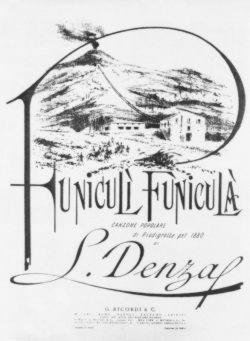
"Funiculì, Funiculà" é o nome de uma canção famosa escrita pelo jornalista, poeta e cantautor italiano Giuseppe 'Peppino' Turco e musicada por Luigi Denza em 1880. Ela foi composta para celebrar a abertura do primeiro bonde ou funicular (em italiano: funicolare) do Monte Vesúvio, em 1879. Foi cantada pela primeira vez em Castellammare di Stabia no Hotel Quisisana no dia 6 de junho de 1880 e se tornou um grande sucesso. No mesmo ano, foi apresentada por Turco e Denza no Festival de Piedigrotta[1][2].

Índice


Plágio involuntário

Seis anos após Funiculì, Funiculà ter sido criada, o compositor alemão Richard Strauss escutou essa música quando viajava pela Itália. Imaginando tratar-se de uma canção folclórica, ele incorporou-a em sua sinfonia Aus Italien. Denza abriu um processo contra ele e ganhou, forçando Strauss a pagar-lhe royalties todas as vezes em que Aus Italien fosse executada em público.[3]

Letra original (em dialeto napolitano)

Aieressera, oì nanninè, me ne sagliette,
tu saie addò tu saie addò
Addò 'stu core 'ngrato cchiù dispietto farme nun pò!
Addò lo fuoco coce, ma si fuie
te lassa sta!
E nun te corre appriesso, nun te struie, 'ncielo a guardà!...
Jammo, jammo 'ncoppa, jammo jà,
funiculì, funiculà!

Nè... jammo da la terra a la montagna! no passo nc'è!

Se vede Francia, Proceta e la Spagna...
Io veco a tte!
Tirato co la fune, ditto 'nfatto,
'ncielo se va..
Se va comm' 'à lu viento a l'intrasatto, guè, saglie sà!
Jammo, jammo 'ncoppa, jammo jà,
funiculì, funiculà!

Se n' 'è sagliuta, oì nè, se n' 'è sagliuta la capa già!

È gghiuta, pò è turnata, pò è venuta...
sta sempe ccà!
La capa vota, vota, attuorno, attuorno,
attuorno a tte!
Sto core canta sempe
nu taluorno
Sposammo, oì nè!
Jammo, jammo 'ncoppa, jammo jà,
funiculì, funiculà!

Tradução para o português

Ontem à tarde, meu amor, eu fui,
sabes para onde, sabes para onde?
Para onde este coração ingrato não pode me desprezar mais!
Onde o fogo queima, mas se tu foges
ele deixa estar!
E não te persegue, não te consome,para que vejas o céu!...
Vamos juntos, vamos lá,
de funicular, subindo de funicular!

Vamos do sopé à montanha, meu amor! Sem (termos de) caminhar!

Podes ver a França,a Prócida e a Espanha...
e eu te vejo!
Puxados por uma corda, antes de nos darmos conta,
vamos para o céu...
Vamos rápidos como o vento e de repente, já saímos!
Vamos juntos, vamos lá,
de funicular, subindo de funicular!

Subimos, meu amor, já chegamos ao topo!

(O funicular) Foi, e retornou, e voltou novamente...
Está sempre aqui!
O topo gira, gira, ao redor, ao redor,
ao redor de ti!
Este coração canta sempre
e não é arrogante
Vamos nos casar, meu amor!
Vamos juntos, vamos lá,
de funicular, subindo de funicular!

Traduzido com ajuda do dicionário da "Storia di Napoli" [1]

Referências

  1. http://www.portanapoli.com/Ita/Cultura/canzone-napoletana/funiculi.html História da música e letras no dialeto napolitano e em italiano.
  2. http://www.vesuvioinrete.it/news/20082001.htm Texto em italiano que conta a história da criação da música.
  3. http://en.wikipedia.org/wiki/Funiculi_Funicula Este trecho foi traduzido diretamente da Wikipédia em inglês.

Ligações externas


.

domingo, 11 de julho de 2010

OLASZ DALOK FUNICULI, FUNICULA


.
.
kkalinkati | 22 de Abril de 2009
CLAUDIO VILLA
.
.
Funiculi ' funicula '
(music of Luigi Denza, text of Peppino Turco, 1880)
The song was written by journalist Peppino Turco and was set by Luigi Denza in 1880. They drew the inspiration from the inauguration of the first funicular of Mt.Vesuvius. They composed this music in few hours, and in spite of that the song met with success. The famous melody was sang the first time in the rooms of Quisisana Hotel in Castellammare di Stabia. Turco and Denza presented it to the Piedigrotta's day in the same year. The success roused contributed to diffuse Neapolitan song in the world and to recall a lot of tourists.
 

Luigi Denza born on 24 February 1846 in Castellemmare di Stabia, Italy. He studied music under Saverio Mercadante and Paolo Serrao at the Naples Conservatory. After graduation, he began to compose opera music. In 1884, he moved to London to pursue his career as a composer. He was appointed Professor of singing at the Royal Academy of Music in 1898. He died in London on 27 January 1922
Peppino Turco born on 7 march 1846 and died on 14 October 1903 in naples, Italy. Initially he was a renowned journalist and poet, collaborating with the satirical newspaper Capitan Fracassa in Rome and various Neapolitan periodicals. However it is for his verses put to music that he is best known. He lived in Rome for much of his life.

Original text - Neapolitan dialect English language text

  1. Aieressera, oi' ne', me ne sagliette,
    tu saie addo'?
    Addo' 'stu core 'ngrato cchiu' dispietto farme nun po'!
    Addo' lo fuoco coce, ma si fuie
    te lassa sta!
    E nun te corre appriesso, nun te struie, 'ncielo a guarda'!...
    Jammo 'ncoppa, jammo ja',
    funiculi', funicula'!


  2. Ne'... jammo da la terra a la montagna! no passo nc'e'!
    Se vede Francia, Proceta e la Spagna...
    Io veco a tte!
    Tirato co la fune, ditto 'nfatto,
    'ncielo se va..
    Se va comm' 'a lu viento a l'intrasatto, gue', saglie sa'!
    Jammo 'ncoppa, jammo ja',
    funiculi', funicula'!


  3. Se n' 'e' sagliuta, oi' ne', se n' 'e' sagliuta la capa già!
    E' gghiuta, po' e' turnata, po' e' venuta...
    sta sempe cca'!
    La capa vota, vota, attuorno, attuorno,
    attuorno a tte!
    Sto core canta sempe
    nu taluorno
    Sposammo, oi' ne'!
    Jammo 'ncoppa, jammo ja',
    funiculi', funicula'!

  1. Do you know
    where I got on, yesterday evening, baby?
    Where this ungrateful heart can't be spiteful to me more!
    Where the fire burns, but if you
    run away it let you go!
    And it doesn't run after you,
    doesn't tire you, looking at sky!...
    Let go on, let go, let go,
    funiculi', funicula'!

  2. We go from the ground to the
    mountain, baby! Without walking!
    You can see France, Procida and
    Spain...
     I see you!
    Pulled by a rope, no sooner said
    than done, we go to the skies..
    We go like the wind all of a sudden, go up, go up!
    Let go on, let go, let go,
    funiculi', funicula'!


  3. The head has already got on,
    baby, got on!
    It has gone, then returned, then
    come...
    It is still here!
    The head turns, turns, around,
    around,
    around you!
    This heart always sings one of these days Get married to me, baby!
    Let go on, let go, let go,
    funiculi', funicula'!

.http://www.vesuvioinrete.it/funicolare/e_funicolare_funiculi.htm
.
.

Funiculì, Funiculà

From Wikipedia, the free encyclopedia

 
"Funiculì, Funiculà"
("Funiculì, Funiculà")
Music by Luigi Denza
Lyrics by Peppino Turco
Published 1880
Language Neapolitan
Performed by Mario Lanza
.
"Funiculì, Funiculà" is a famous song written by Italian journalist Peppino Turco and set to music by Italian composer Luigi Denza in 1880. It was composed to commemorate the opening of the first funicular cable car on Mount Vesuvius. The 1880 cable car was later destroyed by the eruption of Vesuvius in 1944. The song was sung for the first time in the Quisisana Hotel in Castellammare di Stabia and met with huge success. It was presented by Turco and Denza at the Piedigrotta festival during the same year. Edward Oxenford, an English songwriter and translator of libretti, published a version which became somewhat traditional in English-speaking countries.

Contents

  .

Unintentional plagiarism

Six years after "Funiculì, Funiculà" was composed, German composer Richard Strauss heard the song while on a tour of Italy. Thinking that it was a traditional Italian folk song, he later incorporated it into his Aus Italien tone poem. Denza filed a lawsuit against Strauss and eventually won. Strauss was forced to pay him a royalty fee every time the Aus Italien was performed in public.

Original Neapolitan lyrics

Aieressera, oì Nanninè, me ne sagliette,
tu saie addò tu saie addò
Addò 'stu core 'ngrato cchiù dispietto
Farme nun pò!
Addò lo fuoco coce, ma si fuie
te lassa sta!
E nun te corre appriesso, nun te struie
sulo a guardà.
Jamme, jamme 'ncoppa, jamme jà,
funiculì, funiculà!

Nè, jamme da la terra a la montagna! no passo nc'è!
Se vede Francia, Proceta e la Spagna...
Io veco a tte!
Tirato co la fune, diritto 'nfatto,
'ncielo se va.
Se va comm' 'à lu viento a l'intrasatto, guè, saglie sà!
Jamme, jamme 'ncoppa, jamme jà,
funiculì, funiculà!

Se n' 'è sagliuta, oì Nè, se n' 'è sagliuta, la capa già!
È gghiuta, pò è turnata, pò è venuta,
sta sempe ccà!
La capa vota, vota, attuorno, attuorno,
attuorno a tte!
Sto core canta sempe
nu taluorno
Sposamme, oì Nè!
Jamme, jamme 'ncoppa, jamme jà,
funiculì, funiculà! [1]

English translation

Yesterday evening, O Nannina [short for Carolina], I climbed up,
Do you know where?
To where an ungrateful heart can no longer vex me!
Where a fire is burning, but if you flee
It lets you be.
It doesn't chase you, doesn't melt you, with just one glance!
Let's go, let's go, let's go to the top,
Funiculì, funiculà, funiculì, funiculà!
Let's go to the top, Funiculì, funiculà!

Let's go from here below up to the mountain, O Nannina, a step away!
You can see France, Procida, and Spain,
And I see you!
You rise, pulled by a cable, quick as a wink
into the sky.
We'll rise up like the wind all of a sudden knows how to do!
Let's go , let's go, let's go to the top,
Let's go, let's go, let's go to the top,
Funiculì, funiculà, funiculì, funiculà!
Let's go to the top, Funiculì, funiculà!

My brain has gone up there, O Nannina, has gone up there already!
It got there, turned around, and then returned:
It's always here!
My mind is turning, turning, around and round,
Encircling you!
This heart of mine is always singing
the same refrain:
"Marry me, O Nannina"!
Let's go, let's go, let's go to the top,
Funiculì, funiculà, funiculì, funiculà!
Let's go to the top, Funiculì, funiculà![2]

[edit] Traditional English lyrics


Sheet music version
An English version of the song is subtitled "A Merry Life".[3]
.
.
Some think the world is made for fun and frolic,
And so do I! And so do I!
Some think it well to be all melancholic,
To pine and sigh; to pine and sigh;
But I, I love to spend my time in singing,
Some joyous song, some joyous song,
To set the air with music bravely ringing
Is far from wrong! Is far from wrong!
Listen, listen, echoes sound afar!
Funiculì, funiculà, funiculì, funiculà!
Echoes sound afar, funiculì, funiculà!

Ah me! 'tis strange that some should take to sighing,
And like it well! And like it well!
For me, I have not thought it worth the trying,
So cannot tell! So cannot tell!
With laugh, with dance and song the day soon passes
Full soon is gone, full soon is gone,
For mirth was made for joyous lads and lasses
To call their own! To call their own!
Listen, listen, hark the soft guitar!
Funiculì, funiculà, funiculì, funiculà!
Hark the soft guitar, funiculì, funiculà![4]

References in popular culture

  • "Funiculì, Funiculà" without lyrics was played as the theme music of the radio comedy soap opera Lorenzo Jones and his wife Belle which ran from 1937-1955 on various networks.
  • A spoof was once made replacing the traditional lyrics with disparaging lyrics about school food.
  • Another spoof was performed by Jewish cantor and parody artist Seymour Rockoff on "Rechnitzer Rejects, vol. 6", called "Shabbos Bei Dem Tish", with Yiddish lyrics poking fun at the singer's wife's frozen Sabbath food.
  • "Funiculì, Funiculà" was a popular hit song performed by Mario Lanza in the 1950s. The melody is the same as the 1800s version, but the lyrics are in English and also changed to have a different theme, i.e. "Love is everywhere, funiculì, funiculà".
  • "Funiculì, Funiculà" is referenced in the song "Ferryboat Serenade" by the The Andrews Sisters
  • The 1947 Disney cartoon "Mickey and the Beanstalk" uses the melody from "Funiculì, Funiculà" when Goofy and Donald Duck sing a song about food, including the words "I wanna eat 'n eat, 'n eat, 'n eat, 'n eat until I die" as the last line of the chorus.
  • In 1974 Japanese anime cartoon "Little Meg Witch Girl/Majokko megu chan" by Toei Animation, Meg, his sister and his brother sing Funiculì Funiculà in Japanese language, when travelling with rack railway in the episode featuring a school mountain picnic.
  • The Gipsy Kings song, "Que Sí, Que No" from their 1997 album Compas, uses the melody of "Funiculì, Funiculà".
  • In the 1983 film Easy Money, Rodney Dangerfield sings "Funiculì, Funiculà" (the English version) at his daughter's backyard wedding reception.
  • In the 1994 film Heavenly Creatures, directed by Peter Jackson, the characters Pauline and Juliet are fans of Mario Lanza. In one scene, Pauline is making love to John the lodger and has a bizarre daydream to escape the moment. "Funiculì, Funiculà" is playing in the background.
  • "Funiculì, Funiculà" can be heard in the "Puppy Love" levels of Earthworm Jim 2, a successful video game first released in 1995.
  • In a two-part "Disneyland" TV movie called Escapade in Florence, Annette Funicello sang a song called "Dream Boy" set to the "Funiculì, Funiculà" tune.
  • Noel Coward's song "In a Bar on the Piccola Marina" includes the lines, "Funiculi, just fancy me, Funicula!" and "Funicula, Funiculi, funic yourself."
  • A version called "City Till I Die (Funiculi Funicula)" by Jon Christos is on an album of Manchester City Football Club songs (2005, Sanctuary Records).
  • Elaine and "The Maestro" sing "Funiculì, Funiculà" while driving in the Maestro's convertible in the 1995 episode of Seinfeld titled "The Maestro".
  • Jerry Garcia of the Grateful Dead often played the easily recognizable notes to "Funiculì, Funiculà" during equipment problems at their shows beginning sometime in the mid-Seventies. A fine example of the tune can be found at Internet Archive
  • A parody of the song entitled "The Telephone of Brazil," in which Placido Flamingo sang of his love for his telephone, appeared on Sesame Street in the 1970s. [3] The opera was performed as part of the "Live from the Nestropolitan Opera" series, hosted by Phil Harmonic.
  • A rendition of the song was performed for The Grape Escape Game by Parker Brothers as a television selling strategy in 1992.
  • A jingle for Doodle Dome in 1992 used the melody of the song.
  • It is sung in Golden Boy (1939) by Lee J. Cobb, a young William Holden (his first role), Barbara Stanwyck, Sam Levene, Beatrice Blinn, & William H. Strauss at around 55 minutes into the film.
  • In 1966, Christine Nelson used the tune in "Marvin," a novelty song about a frustrated mother and her misbehaving son.
  • George Formby (Senior) recorded a parody of Funicula in 1907. Becoming very popular, at the time he later recorded a longer version entitled "Plink Plonk" in 1909.
  • The Israeli political satire group, Latma, used the melody in their 2010 song “Three terrors”. YouTube video

References

  1. ^ See Russell Watson's Online lyrics
  2. ^ Translated with some help from the Storia di Napoli online dictionary and | Russell Watson's Online lyrics
  3. ^ *National Institutes of Health page with traditional English lyrics
  4. ^ Sheet music for Funiculì Funiculà (Loosely translation into standard Italian and traditional English version.
.
This page was last modified on 7 July 2010 at 12:09.
.
Para: Victor
Assunto: Bom descanso!
Data: 11/Jul 14:24
Beijos mil da Judite

.
.